 +86-13376814803
 robert@hzhongtai.com


For indoor growers, humidity control is one of the most important parts of maintaining a healthy growing environment. But measuring relative humidity (RH) alone does not always tell the complete story. This is where Vapor Pressure Deficit (VPD) comes in.
VPD considers both temperature and humidity to estimate the drying force between plant leaves and the surrounding air. For commercial grow rooms, understanding the relationship between VPD, RH, temperature, and dehumidification can help growers create a more stable environment for plant growth.
What Is VPD?
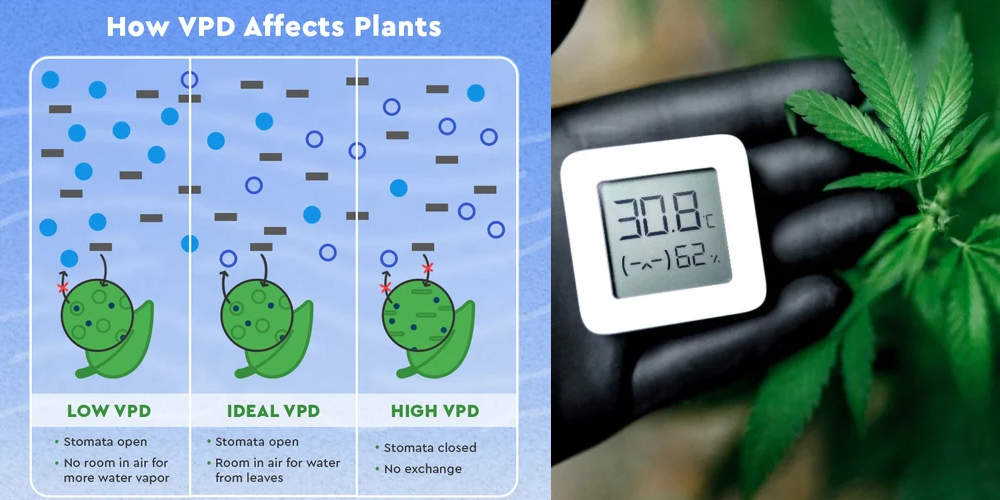
Vapor Pressure Deficit (VPD) describes the difference between the amount of moisture the air can hold at a particular temperature and the amount of moisture it actually contains.
In simple terms, VPD indicates how strongly the surrounding air can draw water from plant leaves through transpiration.
Low VPD: The air is highly humid and has less capacity to absorb additional moisture.
High VPD: The air is relatively dry and can pull moisture from leaves more aggressively.
Moderate VPD: Plants can generally maintain a more balanced rate of transpiration.
Unlike RH, VPD is strongly influenced by both air temperature and humidity.
This makes VPD particularly useful for indoor cultivation, where growers have precise control over temperature, lighting, irrigation, airflow, and humidity.
VPD vs. Relative Humidity: What's the Difference?
Relative humidity tells you how much moisture is in the air relative to its moisture-holding capacity at a specific temperature.
VPD goes one step further by considering the relationship between temperature, RH, and plant transpiration.
For example, 60% RH at 20°C and 60% RH at 30°C do not create the same moisture environment for a plant.
Therefore:
RH describes the moisture condition of the air, while VPD provides a better indication of the air's drying force on the plant.
This illustrates why maintaining a fixed RH percentage does not necessarily mean maintaining the same plant environment.
Why Is VPD Important in a Commercial Grow Room?
In a commercial grow room, plants can release a substantial amount of water vapor through transpiration. Irrigation, evaporation, and plant density can further increase the moisture load.
If the moisture generated by the crop exceeds the room's dehumidification capacity, RH can rise quickly.
High humidity may contribute to:
Excessive condensation
Poor moisture management
Reduced transpiration
Increased risk of fungal and microbial problems
Inconsistent growing conditions
Greater difficulty maintaining the desired VPD
A commercial grow room dehumidifier helps remove this excess moisture and provides growers with greater control over RH and VPD.
Recommended VPD and RH by Plant Growth Stage
There is no universal VPD target for every plant or cultivar. Temperature, lighting, CO₂, root-zone moisture, plant genetics, and cultivation methods all influence the ideal environment.
The following ranges can be used as general reference values for indoor cultivation rather than strict targets.
| Growth Stage | Typical Temperature | Reference RH | Approx. VPD Range |
| Seedling / Clone | 22–26°C | 65–75% | 0.6–0.9 kPa |
| Early Vegetative | 23–27°C | 60–70% | 0.8–1.1 kPa |
| Late Vegetative | 23–28°C | 55–65% | 1.0–1.3 kPa |
| Early Flowering | 22–27°C | 50–60% | 1.1–1.4 kPa |
| Mid Flowering | 21–27°C | 45–55% | 1.2–1.5 kPa |
| Late Flowering | 20–26°C | 40–50% | 1.3–1.6 kPa |
These figures are reference ranges, not universal prescriptions. Growers should adjust environmental targets according to the crop, cultivar, growth stage, lighting intensity, and cultivation system.
VPD Chart for Indoor Grow Rooms
A VPD chart can help growers understand how temperature and RH interact.
For example, at the same temperature, increasing RH generally reduces VPD. At the same RH, increasing temperature generally increases VPD.
The chart demonstrates an important principle:
You cannot determine VPD from RH alone. Temperature must also be considered.
What Happens When VPD Is Too Low?
When VPD is too low, the surrounding air is already close to saturation.
This can reduce the plant's ability to release water through transpiration.
Potential consequences include:
Reduced transpiration
Slower nutrient movement
Excess moisture around leaves
Condensation risk
More challenging humidity management
In a dense commercial grow room, plant transpiration can increase dramatically as the crop develops. Without sufficient dehumidification capacity, RH can remain elevated even when HVAC cooling is operating.
What Happens When VPD Is Too High?
A high VPD means the air has a strong capacity to absorb moisture.
Plants may lose water rapidly through transpiration, potentially resulting in:
Excessive water loss
Plant stress
Increased irrigation demand
Leaf curling or wilting
Reduced growth under severe conditions
Therefore, lowering humidity is not always better.
The objective is not to achieve the lowest possible RH. Instead, growers should aim for an appropriate relationship between temperature and humidity for the crop and growth stage.
How Does a Commercial Grow Room Dehumidifier Help Control VPD?
A commercial grow room dehumidifier does not directly "set" VPD. Instead, it removes moisture from the air, allowing growers to control RH and consequently influence VPD.
A typical control strategy may look like this:
Plants transpire → moisture enters the air → RH rises → dehumidifier removes moisture → RH decreases → VPD changes
This is why dehumidification is an important part of a commercial grow-room HVAC strategy.
For large indoor cultivation facilities, a dehumidifier should be selected based on factors such as:
Grow room size
Plant density
Expected transpiration
Irrigation volume
Temperature
Target RH
Operating hours
Heat load
Drainage requirements
Available electrical power
Simply selecting a dehumidifier based on floor area may result in insufficient or excessive capacity.
Why Choose a Ceiling-Mounted Grow Room Dehumidifier?
For commercial cultivation, ceiling mounted dehumidifiers can provide several practical advantages over portable floor units.
1. Save Valuable Floor Space
A ceiling-mounted unit keeps equipment off the cultivation floor, leaving more room for plants, walkways, carts, and other equipment.
2. Improve Air Distribution
Positioning the dehumidifier above the crop can help distribute dry air throughout the growing space when the system is properly designed.
3. Support Continuous Operation
Commercial grow rooms often require continuous environmental control. A dedicated wall mount dehumidifier can be integrated into the facility's overall HVAC and climate-control strategy.
4. Simplify Large-Room Installation
For larger cultivation spaces, ceiling-mounted equipment can provide a cleaner installation compared with placing multiple portable units throughout the room.
PREAIR Guard Series: Ceiling-Mounted Dehumidifiers for Commercial Grow Rooms
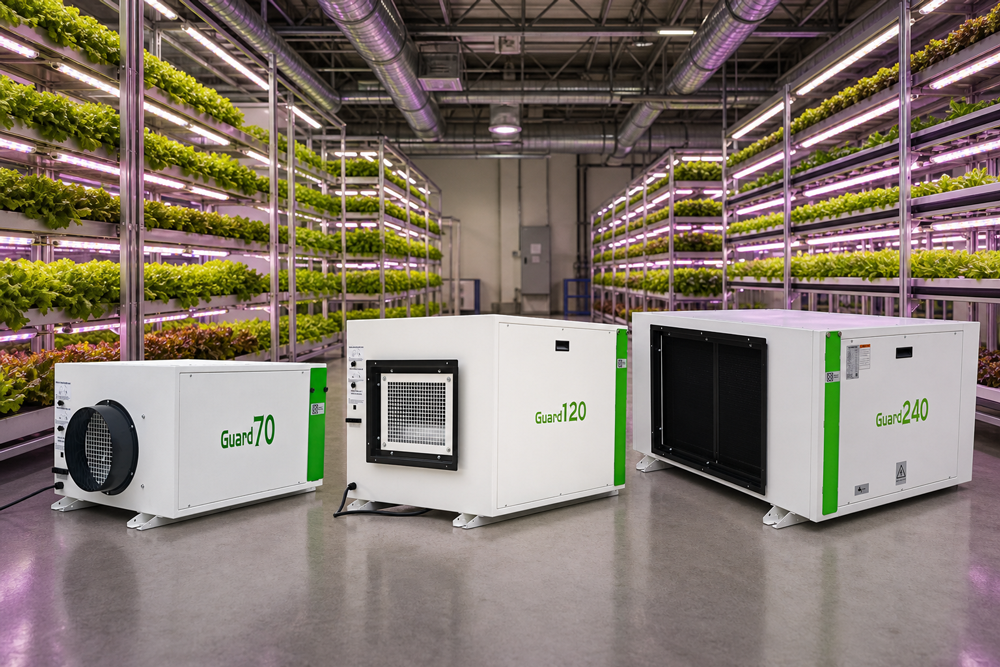
For commercial grow rooms that require continuous humidity management, the PREAIR Guard Series provides ceiling-mounted dehumidification options in different capacities.
The Guard 70L, Guard 120L, and Guard 240L models can be considered according to the moisture load and environmental requirements of the growing space.
PREAIR Guard 70L Dehumidifier
The Guard 70L Dehumidifier is suitable for smaller commercial cultivation areas and spaces where floor space is limited.
Its ceiling-mounted configuration allows the unit to be positioned above the working area while providing dedicated humidity control.
PREAIR Guard 120L Dehumidifier
For medium-sized grow rooms or areas with a higher moisture load, the Guard 120L Dehumidifier provides greater dehumidification capacity.
It can be incorporated into a commercial grow-room climate-control system where stable RH is important for maintaining the desired VPD range.
PREAIR Guard 240L Dehumidifier
For larger commercial cultivation environments with substantial moisture generation, the Guard 240L Dehumidifier provides significantly higher moisture-removal capacity.
Its ceiling-mounted design is particularly useful where floor-mounted equipment would interfere with cultivation operations or available floor space.
The exact number of units required should be determined from the room's moisture load rather than room area alone.
How to Select the Right Commercial Grow Room Dehumidifier
When choosing between a 70L, 120L, or 240L ceiling mounted dehumidifier, consider the total moisture load.
A simplified approach is:
Required dehumidification capacity ≈ plant transpiration + irrigation/evaporation + infiltration + other moisture sources
For example, a room with a large mature crop can generate significantly more moisture than the same room during the early vegetative stage.
This means that dehumidification requirements can change throughout the cultivation cycle.
For commercial projects, it is better to calculate the moisture load and then select the appropriate combination of units rather than choosing equipment solely according to square footage.
VPD Control Requires More Than a Dehumidifier
A dehumidifier is an important component, but VPD management requires a complete environmental-control strategy.
A commercial grow room may need to coordinate:
Temperature control
Relative humidity control
VPD monitoring
Air circulation
HVAC
Lighting
Irrigation
CO₂ management
Dehumidification
Environmental sensors
For example, if the room temperature increases while RH remains constant, VPD can increase. If the dehumidifier lowers RH while temperature remains stable, VPD can also increase.
Therefore, growers should monitor both temperature and RH, while using VPD as a plant-focused indicator.
VPD vs. Humidity: Which One Should You Monitor?
The answer is both.
RH remains important because it directly describes the moisture level of the grow-room air and helps identify condensation and excessive humidity.
VPD is valuable because it translates temperature and humidity into a metric that is more closely related to plant transpiration.
A practical commercial grow-room strategy is:
Measure temperature → measure RH → calculate VPD → control humidity → monitor plant response
This approach is more reliable than simply setting the dehumidifier to a fixed RH percentage without considering temperature.
Final Thoughts: Is VPD More Important Than Humidity?
VPD is not a replacement for humidity control.
Instead, VPD provides another layer of information that can help growers understand how temperature and humidity affect plant transpiration.
For commercial indoor cultivation, the best approach is to manage temperature, RH, and VPD together.
A properly sized commercial grow room dehumidifier is essential when plant transpiration creates a significant moisture load. Ceiling-mounted solutions such as the PREAIR Guard 70L, Guard 120L, and Guard 240L can help commercial growers manage excess moisture while making efficient use of valuable cultivation floor space.
Ultimately, the goal is not simply to achieve a low RH number. The goal is to create a stable, crop-appropriate environment in which temperature, humidity, VPD, airflow, and irrigation work together.
Post time: Oct-09-2026


