 +86-13376814803
 robert@hzhongtai.com


Gymnasium changing rooms are high-humidity environments due to showers, wet towels, sweaty clothing, and frequent use. If humidity is not properly controlled, changing rooms can develop unpleasant odors, mold growth, condensation, and damage to building materials.
Maintaining the right humidity level improves indoor air quality, protects facilities, and creates a more comfortable experience for athletes and visitors.
Why Is Humidity High in Gym Changing Rooms?
Several factors contribute to moisture buildup:
1. Showers and Hot Water Use
Hot showers release large amounts of water vapor into the air. Without sufficient ventilation, this moisture remains trapped indoors.
2. Wet Clothing and Towels
Sports clothing, towels, and equipment release moisture as they dry, increasing the room’s relative humidity.
3. High Occupancy
Many people exercising at the same time introduce additional moisture through sweat and breathing.
4. Poor Ventilation
Insufficient air exchange allows humid air to accumulate, especially in enclosed locker rooms.
What Humidity Level Should a Gym Changing Room Maintain?
The recommended relative humidity level for a gym changing room is generally:
|
Humidity Level |
Condition |
|
40%–60% RH |
Comfortable and acceptable |
|
50%–55% RH |
Ideal for preventing mold and odors |
|
Above 60% RH |
Increased risk of mold growth and condensation |
|
Above 70% RH |
High moisture risk |
Keeping humidity around 50%–55% RH is often a good target for locker rooms and changing areas.
Effective Ways to Control Humidity in Changing Rooms
1. Install a Commercial Dehumidifier
A commercial dehumidifier is one of the most effective solutions for maintaining stable humidity levels in large changing rooms.
Benefits of dehumidifiers include:
Removes excess moisture from the air
Prevents mold and mildew growth
Reduces musty odors
Protects walls, ceilings, and equipment
Maintains consistent humidity during peak hours
For gyms with heavy daily use, a dedicated dehumidification system is often more reliable than relying only on HVAC systems.
Recommended dehumidifier applications:
Fitness centers
Sports clubs
Swimming pool changing rooms
School gym facilities
Indoor sports complexes
2. Improve Ventilation and Air Exchange
A proper ventilation system helps remove humid air and bring in fresh air.
Effective ventilation methods include:
Exhaust fans
Mechanical ventilation systems
Heat recovery ventilation (HRV) systems
Demand-controlled ventilation
Exhaust fans should be installed near major moisture sources, such as:
Shower areas
Restrooms
Wet floors
However, ventilation alone may not be enough in humid climates or during peak usage because outdoor air can also contain high moisture levels.
3. Use HVAC Systems with Proper Dehumidification
Many gyms rely on air conditioning systems for temperature control, but cooling does not always provide enough moisture removal.
A properly designed HVAC system should consider:
Indoor humidity load
Number of occupants
Shower moisture generation
Outdoor climate conditions
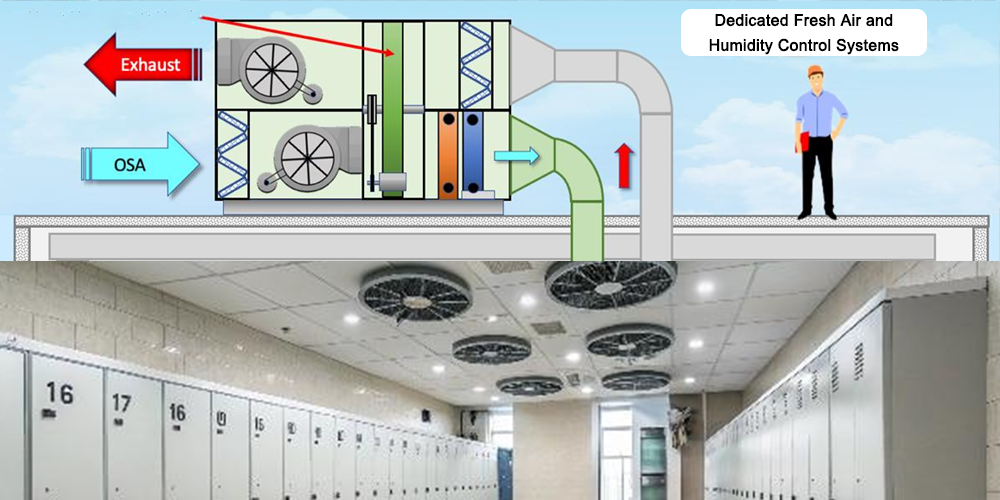
In warm and humid regions, additional dehumidification may be required even when the room temperature feels comfortable. Preair WH series dehumidifier for HVAC system are totally fit for the dehumidification of the changing room. They have large capacities ranging from 70-135 PPD, MERV-8 filters, fresh air intake, remote control, and auto-restart functions. The entire system can be installed in a concealed manner without occupying indoor space.
4. Increase Air Circulation
Fans improve air movement and help prevent stagnant, humid areas.
Useful equipment includes:
Ceiling fans
Wall-mounted circulation fans
Air movers during cleaning
Exhaust ventilation fans
Fans do not remove moisture themselves, but they help distribute dry air and improve drying efficiency.
5. Manage Shower Area Moisture
Since showers are one of the largest moisture sources, consider:
Running exhaust fans during and after shower use
Installing automatic humidity sensors
Using shower timers
Ensuring proper drainage
Drying wet floors quickly
6. Monitor Humidity Levels
Installing humidity sensors allows facility managers to identify moisture problems early.
A smart humidity control system can:
Automatically start dehumidifiers
Adjust ventilation rates
Record humidity trends
Reduce unnecessary energy consumption
Choosing the Right Dehumidifier for a Gym Changing Room
The required capacity depends on:
Room size
Number of users
Shower facilities
Climate conditions
Ventilation rate
For commercial applications, factors such as liters/day moisture removal capacity, airflow volume, operating temperature range, and continuous drainage capability should be considered.
Common choices include:
|
Dehumidifier Type |
Suitable Application |
|
Commercial refrigerant dehumidifier |
Fitness rooms, locker rooms, gyms |
|
High-capacity industrial dehumidifier |
Large sports facilities |
|
Pool-area ceiling dehumidifier |
Swimming pools and humid environments |
|
Desiccant dehumidifier |
Low-temperature or special applications |
Additional Tips to Reduce Humidity Problems
Dry wet floors quickly after cleaning
Avoid storing damp towels indoors
Maintain HVAC filters regularly
Seal leaks around plumbing fixtures
Use moisture-resistant wall and ceiling materials
Clean drains regularly to prevent odors
Final Thoughts
Controlling humidity in a gymnasium changing room requires more than simply increasing airflow. The most effective approach combines commercial dehumidification, proper ventilation, air circulation, humidity monitoring, and moisture management practices.
By maintaining indoor humidity around 50%–55% RH, gyms can reduce mold risk, improve air quality, protect facilities, and provide a cleaner, more comfortable environment for athletes and visitors.
Post time: Jul-07-2026


